
Six hours. That’s how long it took me to write a cancellation policy.
Not to see a client. Not to land a referral partner. Not to do a single thing that looks like “real” business from the outside. Just me, a blank Google Doc, and the surprisingly hard job of putting into words exactly what happens when someone no-shows.
I do this for a living. My whole background is the operations side — years spent inside practices helping owners with their bookkeeping and their systems — and even I sat there around hour four wondering if I was wasting a perfectly good afternoon.
Here’s what that boring little document has done in the eighteen months since. It’s saved me dozens of awkward “do I charge them or not” conversations. It’s recovered thousands of dollars in fees I used to wave off out of guilt. And it quietly deleted the Sunday-night dread of “what happens if someone cancels tomorrow and I have to figure it out in the moment.”
Six hours of boring work. Eighteen months of freedom. That’s the trade nobody puts on a highlight reel.
Why the important work is invisible
There’s a reason nobody posts their cancellation policy on LinkedIn. Backend work doesn’t photograph well. You can’t turn “I finally documented my intake process” into a compelling story. Nobody claps when you organize your client files or set up automatic payment reminders.
Meanwhile, the whole business world celebrates the visible stuff — the new website, the rebrand, the podcast launch. So that’s what we chase. We redesign the logo while the billing is a mess. We dream up a new offer before we have an onboarding process for the offer we already have. We pour money into marketing when we can’t comfortably serve the clients we’ve got.
It’s not that the visible stuff doesn’t matter. It’s that the invisible stuff matters first. I’ve watched an owner spend ten thousand dollars on a new website while quietly leaving fifteen thousand a year in uncollected fees on the table. The glamorous work feels productive. The boring work actually is.
What we mean by “backend”
When we sit down with a practice at Monarch, the backend almost always breaks into the same handful of areas — the ones no graduate program ever covered:
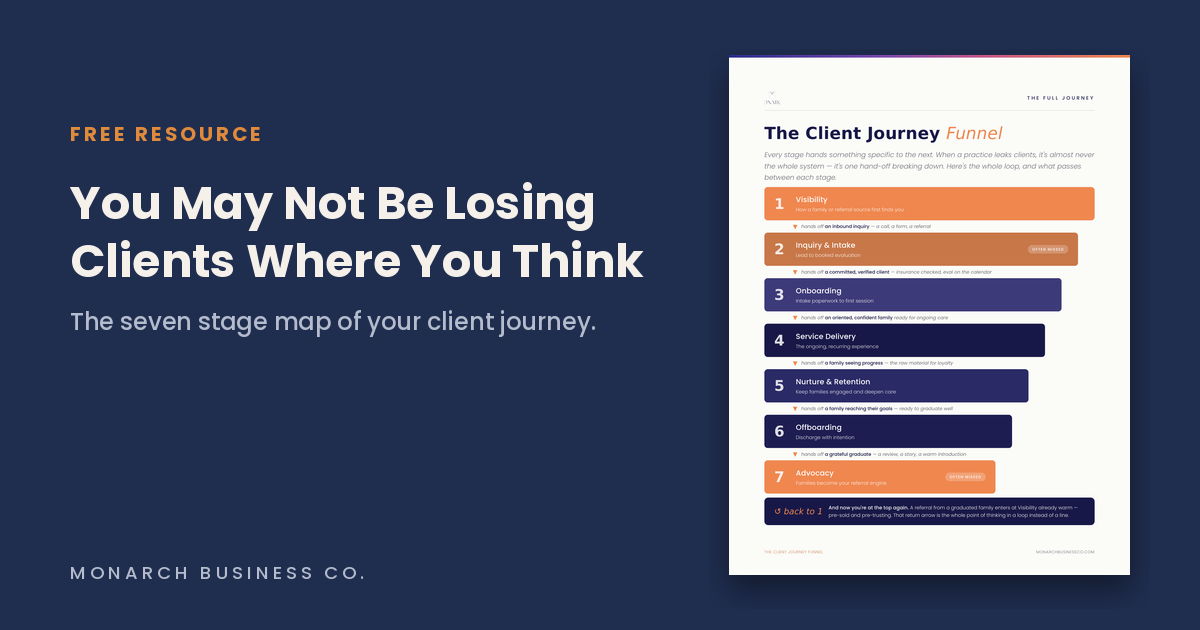
Your financials — actually knowing your numbers instead of guessing at them. Your SOPs — the written processes that live in your head today, so that when an A-player leaves, the knowledge doesn’t walk out the door with them. Your client experience — the whole journey from the moment someone finds you online to the day they discharge. And your automations — the small repetitive tasks that eat your evenings.
None of it is exciting. All of it is load-bearing.
Freedom is the right structure, not the absence of it
Here’s the thing I wish someone had told me sooner: freedom isn’t the absence of structure. Freedom is the presence of the right structure.
When you don’t have a cancellation policy, every no-show becomes a fresh decision. Do I charge them? What if they had a good reason? What if they get upset? Each one is a tiny crisis that costs you real emotional energy. When you do have a policy, the decision is already made. You don’t negotiate with yourself. You follow the system, and the anxiety just isn’t there anymore.
That’s the whole Monarch order of operations, honestly — clarity first, before the crisis, not after it. One hard afternoon now buys you months of ease later.
Why we avoid it anyway
If it’s so valuable, why does everyone put it off? Part of it is the glamour gap. Part of it is the skill gap — you were trained to do clinical work, not to build systems, so the unfamiliarity feels uncomfortable.
But mostly, I think it’s the confrontation. You can’t document an intake process without admitting you don’t really have one. You can’t write a cancellation policy without facing how inconsistent you’ve been. The boring work makes you look straight at the mess.
And I want to be really clear about this: the mess is not a character flaw. It’s just what happens when no one ever taught you the business side. There’s nothing to be ashamed of in the gaps — only something to build.
The quiet payoff
Nobody’s going to feature your payment-reminder automation on a podcast. But you’ll know. You’ll know the next time a cancellation happens and you don’t spiral. When a new client onboards smoothly and you didn’t have to reinvent a single thing. When you open your numbers and they’re just there, accurate and calm.
That’s the freedom. It’s private and hard to photograph and completely real. You don’t have to build it all in one heroic weekend, and you don’t have to build it alone. You just have to start with the one thing that’s costing you the most right now — and give your future self one less fire to put out.