
Almost every practice owner we meet starts the same way. You are a wonderful clinician, and at some point you think, I know what good care looks like, there is no reason I could not do this myself. You are right about the clinical part. It is everything around the clinical part that no one warned you about.
That is the part nobody put on an exam or in a program, and it is the part that quietly runs good owners into the ground. So let us talk about it honestly, from both sides of the table. Between the two of us, we have lived both halves of this story.
The thing nobody says out loud
Meagan, the clinical side. I am a speech language pathologist. I built my first private practice with no business background at all. Just me, a caseload, and a checklist of things I did not fully understand yet. Over four years I grew it into a large multidisciplinary practice, and eventually I sold it. And I learned every business lesson the hard way.
Here is the thing nobody tells you. You can be a wonderful clinician, a real expert in your field, and still be a shaky business owner. I was one of them. In all the years I have coached owners since, the ones who struggle are not struggling because they are bad at the work. They are struggling because no one ever supported them on the business side.
The thing that makes you a great clinician is not the thing that makes you a great owner. They are two different jobs.
When did it hit me? After my first year. I was burning out and I had no money, because I did not know my numbers and I did not really know where anything was going. As clinicians we picture the successful practice as the big shiny one, all the materials and multiple therapists, and we never see the overhead sitting underneath that picture. I did not know what payroll taxes would cost me. I found out about my building tax because the bill showed up in the mail. I signed contracts that first year, my EMR and my marketing, without researching the companies, and got stuck in agreements I could not get out of.
That is the year I hired my first business coach. Not because I had stopped being a good therapist, but because being a good therapist had never once required me to know any of this.
The six things you suddenly have to be good at
Jaclyn, the operations side. I come at this from the opposite direction. My background is operations. I spent years helping practice owners with their bookkeeping, and then more and more with systems, and I watched brilliant clinicians get buried by the day to day of running a business. Not because they were not smart. Because no one had ever taught them how.
The moment you open your doors, you are not only the clinician anymore. You are also the HR manager, the biller, the referral coordinator, the IT person, all of it. Here are the six areas we watch owners struggle with again and again.
- Financials. Knowing where your numbers come from, reading a profit and loss, having a budget, and actually paying yourself.
- HR. Hiring, onboarding, the awkward feedback conversation, letting someone go the right way, and keeping the good people you already have.
- Systems and SOPs. Your written processes. In most small practices nothing is documented, so when an A player leaves, the knowledge walks out the door with them.
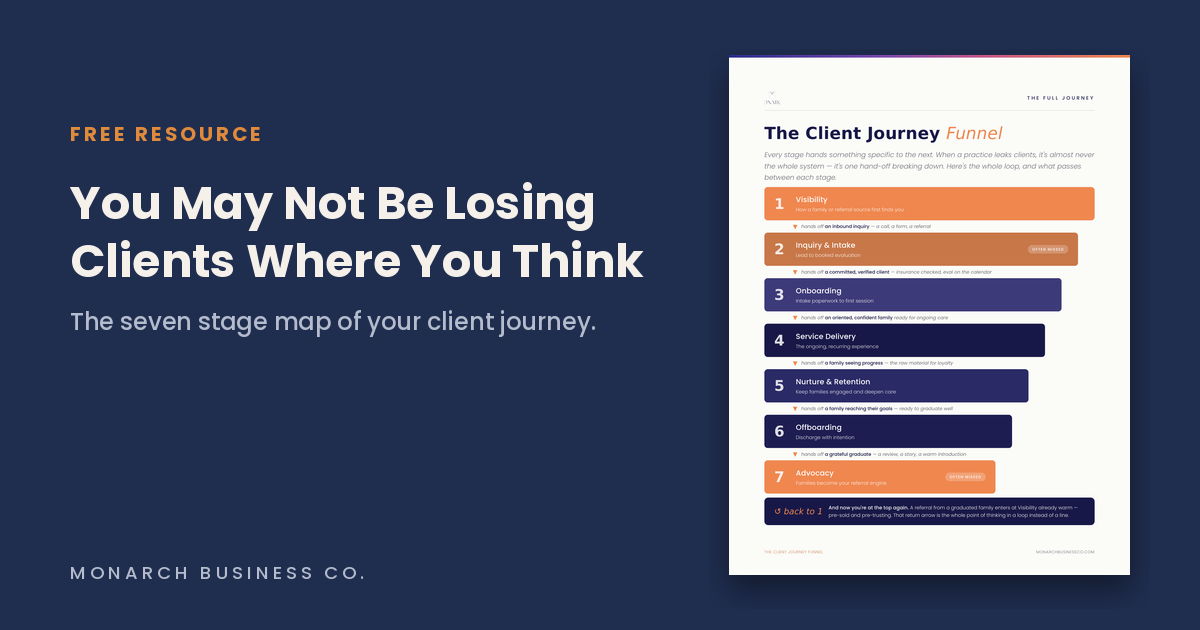
- Client experience. The whole journey, from the first time someone finds you online to the day they discharge.
- Automations. The repetitive tasks that eat your evenings and live in your head.
- Marketing. Filling your caseload on purpose instead of relying on luck.
Not one of these was in your graduate or doctoral program. Every single one of them can make or break your practice.
What it actually feels like
If you own a practice, you probably do not need us to list the symptoms. You take the whole thing home, with no line between owner you and clinician you. You are always playing catch up, because nothing is systematized. You do not really know your numbers, so every decision is a gut decision made out of fear. And you feel far from the reason you started, which is the heartbreaking one, because it was never about the salary.
These are not signs that you are failing. They are signs of a practice built around your clinical identity instead of a real model underneath it.
Here is the good news
Every one of these areas can be fixed. No matter where you are, just starting, growing, or scaling, none of this is permanent and none of it is a verdict on you. The order we exist to reverse is simple. Clarity first, before the crisis, not after it.
That is the whole reason Monarch exists. The clinical eye and the operations eye in the same place, pointed at the practice you actually set out to build.
You were never taught the business, and then you were asked to run one anyway. That is fixable. Book a free consultation and let us look at all six areas together. monarchbusinessco.com/contact