
Here's a scenario that plays out in private practices every single week.
An owner looks at a slow month, a shrinking waitlist, or a caseload that won't quite fill, and reaches the same conclusion almost everyone reaches: I need more clients. So they pour energy into the top of the funnel. More Instagram posts. A boosted ad. A redesigned website. A push to get in front of more referral sources.
Sometimes it works. Often it doesn't. And when it doesn't, the frustrating part isn't the effort. It's that the effort was aimed at the wrong place.
Because most practices aren't actually failing to attract clients. They're failing to keep the ones they attract, or failing to convert the interest they've already earned. The leak isn't at the top of the funnel. It's somewhere in the middle, in a stage nobody mapped, at a handoff nobody built a system for.
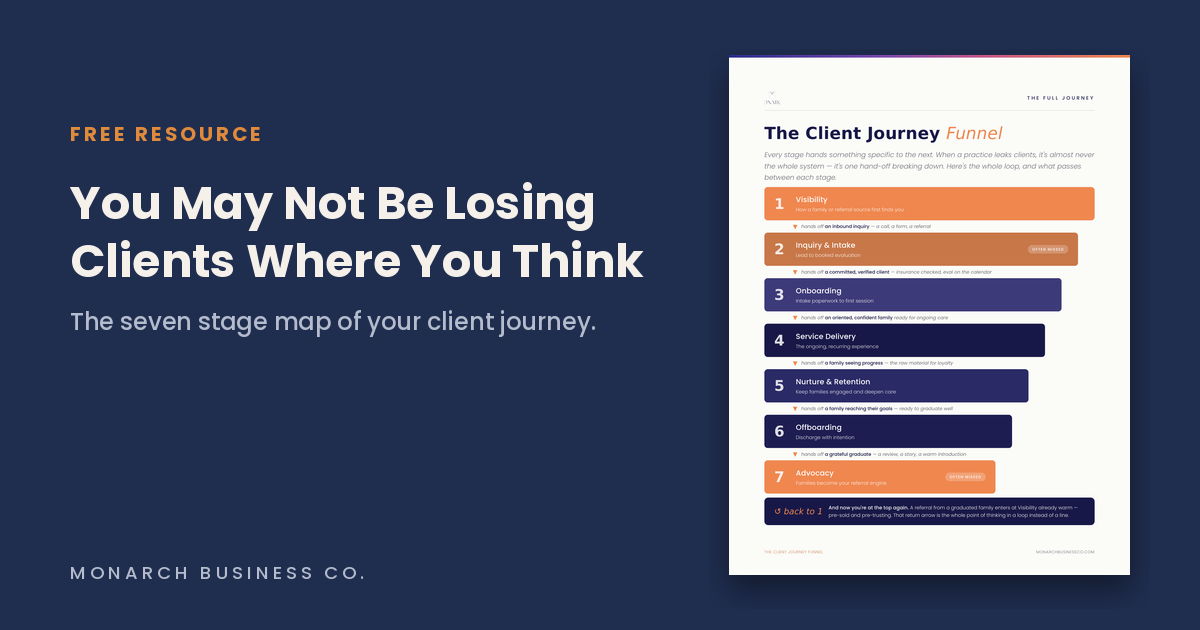
That's the whole idea behind our newest free resource, The Client Journey Funnel. It's a stage by stage map of how a family actually moves through your practice, from the first time they hear your name to the moment they become the referral that brings you the next one.
The journey has seven stages, not three
When most clinician owners picture their client journey, they picture something like this: find them, treat them, done. Marketing, service, exit.
But there are actually seven distinct stages, and each one hands something specific to the next. When you can see all seven, you can finally see where the drop off is happening instead of guessing.
- Visibility. How a shopping parent or a referring provider first encounters your practice. For clinical practices, this is less about paid ads and more about your referral pipeline, your pediatricians, schools, and early intervention coordinators, plus your Google reviews and directory presence.
- Inquiry and Intake. The bridge from interested lead to booked evaluation. This is the stage almost everyone collapses into onboarding, and it's where the biggest revenue leak usually lives. It covers the first call or form, your response time, insurance verification, the copay conversation, and getting that eval on the calendar.
- Onboarding. Intake paperwork, portal setup, scheduling, and the first session experience, from signed intake through the first two weeks of care.
- Service Delivery. The ongoing, recurring experience. Consistency of provider, communication between sessions, home program follow through, billing that doesn't surprise anyone, and progress the family can actually see.
- Nurture and Retention. Keeping families engaged and deepening the relationship, including cross referrals inside your own practice. The OT client who also needs SLP. The eval that surfaces a second area of need.
- Offboarding. The graceful exit. Discharge summaries, transition planning, the message that your door stays open, and the request for feedback while goodwill is at its peak.
- Advocacy. The stage that closes the loop. Discharged and current families become your referral sources, your reviewers, and your testimonials, and that flows straight back into Stage 1.
The two stages almost everyone skips
Look at that list again and notice which stages tend to get the least attention.
It's almost always Inquiry and Intake and Advocacy, the two we flag in the resource as often missed.
They get missed for the same reason. They don't feel like the work. Intake feels like admin. Advocacy feels like something that either happens or it doesn't. So they get left to chance.
But these are precisely the two stages with the highest leverage.
A full day's lag on responding to an inquiry, or a fuzzy explanation of benefits, is where warm leads quietly go cold. Someone was ready to book, and the moment slipped because there was no system to catch it. That stage deserves its own SOP: a defined response time standard and a benefits check script that covers CAQH status, NPI, in network verification, and a plain language copay estimate. Not eventually. Before the next inquiry comes in.
And Advocacy is the single best marketing channel most practices own, running entirely on luck. A referral from a family who graduated happy enters your funnel already warm. They arrive already trusting you and already sold, and they cost far less than any ad you could run. Yet almost no small practice has a deliberate motion for turning satisfied families into reviews and referrals. It's left to hope.
Fix those two stages, and you often don't need more traffic at the top at all.
It isn't really a funnel. It's a flywheel.
Here's the shift this map is really trying to create.
A funnel is something you refill. Clients pour in the top, move down, and exit the bottom, and then you start over, pouring in more. It's exhausting, and it's the mental model that keeps owners stuck in permanent acquisition mode.
A flywheel is different. In a flywheel, the last stage feeds the first. A well handled discharge produces a grateful graduate. That graduate leaves a review, tells another family, and sends a referral, and that referral reenters at Visibility already warm. The system starts spinning itself.
That return arrow, from Advocacy back to Visibility, is the whole point. It's the difference between a practice you have to constantly push and one that builds its own momentum.
And it maps cleanly onto how we think about building a sustainable practice at Monarch: mindset, systems, and accountability. Every stage of the journey sits under one of the Four Pillars, whether that is Financial, HR and Team, Operations, or Client Experience. When a stage leaks, it's almost never the whole system that's broken. It's usually the pillar underneath that one handoff that's starving.
How to use the Client Journey Funnel
The resource is built to be used, not just read.
Inside, you'll find each of the seven stages broken down with the specific handoff it owes the next stage, a Monarch insight on where practices most often go wrong, and, on the final page, a diagnostic worksheet you score yourself.
The worksheet is where it gets practical. You rate each stage from 1, meaning leaking badly, to 5, meaning running like a system, and your lowest scores show you exactly where to work first. If two or more of your low scores cluster under the same pillar, you've found the root cause, not just the symptom.
That's the goal. Not another thing to feel behind on, but a clear, honest picture of where your practice actually stands, and one obvious place to start.
Get the Client Journey Funnel
If you've been feeling like you're working hard to grow and the numbers aren't moving the way they should, this is worth twenty focused minutes. There's a good chance the fix isn't more clients. It's a stronger handoff in a stage you've never named.
Grab your free copy of The Client Journey Funnel on our resources page.
And if you score yourself and realize the leak is bigger than a quick fix, that it's a whole pillar that needs shoring up, that's exactly the work we do inside the Monarch Method. When you're ready, book your free consultation and we'll map your next steps together.
Monarch Business Co. helps private practice owners in SLP, OT, ABA, behavioral health, primary care, and MedSpa build sustainable, profitable practices, without the burnout.